Friday, June 20, 2008

Fog on Friday

It's the time of year we generally label as "June gloom," which sometimes arrives after an extended period of "May gray." One of the joys of living by the ocean when temperatures are changing. On my morning walk over the hill, which began in bright sunshine, a change of wind direction brought this lovely stuff drifting into the canyon below.


It kept right on coming, filling the entire canyon and blanketing the town.


By noon it was gone, and we were all moaning about the heat. Come back, fog! Come back!

Monday, June 16, 2008

Helix Socks are Finished!

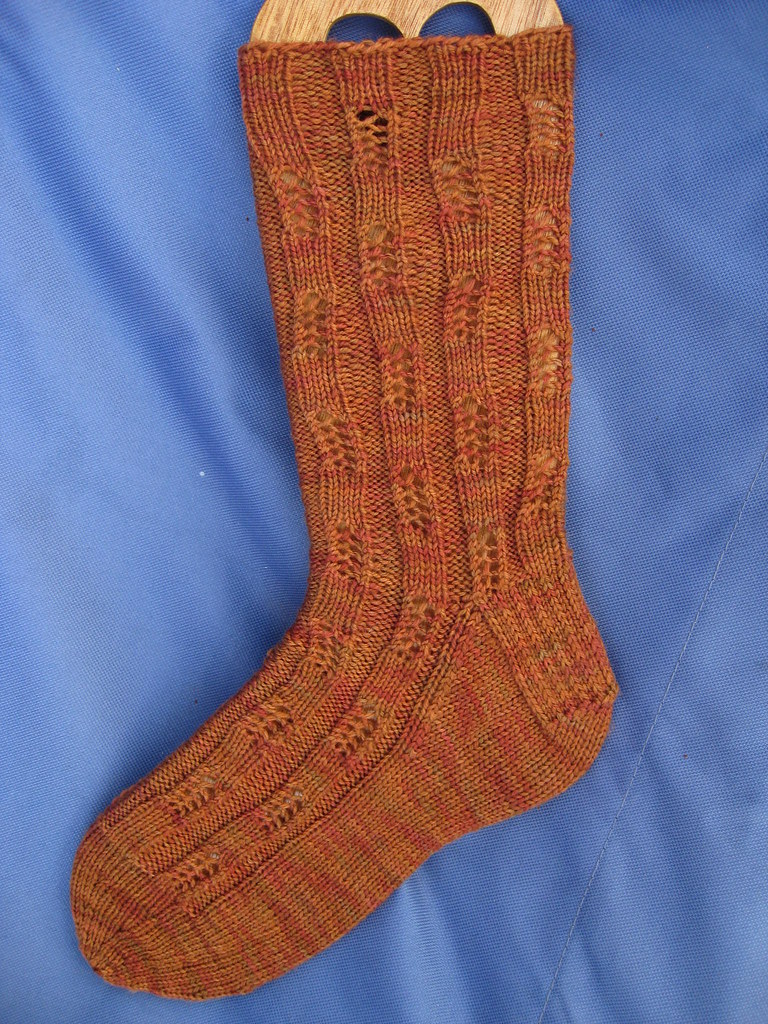
The Mustard Stripe Helix Socks are finished. Here is the first one, posing in the garden.


There are, of course, two.


I really like the helix method of striping – saves one from struggling with the infamous "jog." But it has its limitations. For starters, you can only do one row of each color. If you want a two-row stripe, you need to add another ball of yarn. I found it challenging enough to cope with three little yarn balls. Four might be acceptable, but no more.

I had a lot of fun making these socks and learned a lot too. Some items of interest --

The Cast On – I used the long-tail cast on for both socks. For the first, I cast on in one color, then added each of the others as I got to its section. For the second, I cast each of the three colors on to a separate needle, then joined up (and joined up and joined up). I think you can see the difference in this picture. Either way, though, the top flared out in an unappealing fashion. Might have been the K5, P3 rib. I've used that rib before, but with a K2, P1, K2, P3 cuff. Probably should have done the same here, but I was so befuddled by the color management that I forgot. In the end I did some sewing around the top edge that succeeded in pulling in the flare.


The Toe – I decided to do a round toe, because I simply couldn't imagine how to sort out three ends of yarn while doing a Kitchener stitch. The concept was good, and I had no trouble pulling up the final stitches with the last color worked, maneuvering the other two colors through, and poking all three to the inside. But for some inexplicable reason, I decided to continue the ribbing on the instep for a while, executing those decreases on the K5 panels. Looks stupid. See the pink line? That's where the round toe starts. I could/should have either done a regular round toe in stockinette or done the instep decreases on the purl stitches. Brain was apparently not engaged.


The Heel – The heel is fine. No technical problems. I did, however, make this project more exciting than it needed to be by selecting the yarn of which I had the LEAST amount for the heel.

Often impromptu projects are more entertaining than those more carefully planned. Although these little guys fall short of perfection, we had great times together and I'm going to enjoy wearing them.

Tuesday, June 10, 2008

A New Plying Spindle

As I've learned more about spinning – and especially plying – I've become frustrated with my plying spindle. It's too light. I'm putting more twist into singles nowadays and could use more weight to pull on those kinky strands and get them plied.

So I purchased this lovely creature from the friendly folks at Woodland Woolworks. It's a two-ounce Cascabeles in aromatic cedar. I like the simplicity of the design. And the shaft has just enough 'tooth' to keep the cop from slipping.


And speaking of the shaft -- here it is next to my former plying spindle. That is one loooong shaft, 13 inches actually. The other spindle could just hold 100 grams if I wound on very carefully. This one should have no problem at all.


The Spindle family gathered together to welcome its new member. In the back we have the 1.3 ounce Kundert (now retired from plying). To the left is a .7-oz Spindlewood Square (used to be .75 oz, but a piece broke off the shaft); to the right, a 1-oz Forrester Granny. These two are the workhorses. Generally I spin 1-2 ounces of singles onto each, pop them in the plying box, and we're off. The Bosworth Mini in front is usually reserved for tricky fibers since it has the fastest acceleration of any spindle I've ever encountered. It has, however, proudly spun an entire ounce of merino last week and is eagerly anticipating a trip to the plying box.


I too am eager to see how the next plying session goes.

Thursday, June 5, 2008

Adventures in Spindling

I haven't done any spinning for quite a while. Partly because I had a bunch of knitting projects that clamored to be finished. But mostly because I'd had an unfortunate outcome from spinning a test sample of some new fiber and couldn't decide what to do.

This is the fiber – superwash merino in a mix of purple, orange, turquoise, green, and little squibs of other colors. Very bright and rich. I spun and plied about ten yards of fingering and wound it into a mini-skein. Then I popped the skein into the customary hot water bath and let it sit for 20 minutes.


When I extracted and dried the skein, this is what it looked like – an allover chocolate purple color. Evidently the darkest colors bled and overdyed the other colors. Even the white skein ties emerged medium purple. I was so discouraged that I tucked the fiber back in its box and returned to my knitting.


But then the spindles got restless. (Spindles can be worse than yarn.) They kept tumbling onto the floor or snagging my sleeve with their hooks as I walked past. The worst offender was the Bosworth Mini. Being such a short guy, he sits in a tiny vase near the telephone, and every time I picked up the phone, well . . . .

I surrendered, grabbed MiniBos, pulled out the fiber, and took them both out to the patio for a spindling session. A few sessions later this is what we had – almost a full ounce, which pretty much fills this little spindle. Now I was starting to think – if I could just deal with the color bleeding issue, I might actually get some lovely yarn from this effort. Not that a result is absolutely necessary. Spindling with colorful fiber is a zen thing -- satisfying in itself.


At this point I have nearly another ounce on a second spindle. It looks like less, because this spindle is much larger than MiniBos. It can hold 2-4 ounces easily. So, I'm about ready to ply. Which I will do as usual with my trusting plying box. Or maybe not.


This is the trusty plying box. I have always plied from two long spindles onto an equally large but heavier spindle. Notice how well the two spindles fit into the slots in the box. Will the MiniBos fit into this box? Nooooooo. It is much too short. Erk. I see three options here – find a way to rig MiniBos into the plying box, wind the entire contents of MiniBos onto something that WILL fit into the box, or, possibly, try a different approach to plying. Option number three opens up a whole new realm of possibilities.


And all this fun happens before I even begin to search for a way to finish off this yarn that does not involve immersion in hot water (thereby causing the colors to bleed and overdye). Steaming is one alternative I have turned up. Apparently it's possible to do this with a steam iron or in a pot/rack combination. Anyone ever tried it? I'm wondering, too, if immediate immersion in cold water and vinegar would help to set the colors. Then I could worry about setting the twist. I believe it's the combination of heat and wet that sets the twist, but I'm not sure. My spinning references mandate the use of hot water, but they neglect to say WHY.

The worst-case scenario is that my fingers will have had tons of practice drafting Merino, I will have learned a lot about plying and finishing handspun, and I might even have 400 or so yards of chocolate-purple yarn. I'm good with that.

Wednesday, May 28, 2008

Helix Socks

This pattern from the "Knitting Pattern A Day Calendar 2007" caught my eye because it looked like a fun approach to making stripes. I never reviewed the pattern in any detail, just noted that it instructs you to divide the work into three sections and knit each separately with a different color, dropping and picking up each color as you work around the circle. It has been magneted to my refrigerator for months.


It took some time to come up with adequate quantities of leftover yarn in colors that coordinated nicely. Here they are. Only one is an actual solid (the mustard yellow); another is a variegated in cream and gold, and the last is a semi-solid in light/medium brown. I decided that K5,P3 would display the colors to their best advantage and cast on. But there were problems. Two problems – one immediately obvious and one that I should have noticed long ago.


The first problem drove me nuts for a day or two. I blame the instructions (doesn't one always?). They say to divide the sock into three roughly equal sections (for the three colors), knit with Color A until you encounter Color B, knit with color B until you encounter color C, and knit with color C until you return to Color A. This is, in fact, what you do. But after the first round, the poor knitter is left staring glumly at TWO sections and wondering what happened.

Extensive experimenting with varying quantities of colors led to the development of WoolEnough's Theory of Helix Socks, which states:

Number of Sections = Number of Colors – 1

Try it yourself. Lay out three DPN's as if to knit in the round and park a bit of yarn at each intersection. Then move the yarn around the needles as though you were knitting with it. All goes smoothly until you get to the end of the first round. There you are at the beginning of needle #1, but there is no yarn, because you left it at the end of that needle. Oops.

The division into two sections works well, though, for doing a solid heel. I began knitting the sock in the middle of the stitches designated for the heel, which resulted in one section for the heel and one for the instep. (It would have worked as well to start in the middle of the instep stitches.) When I was ready to start the heel flap I just turned and began purling back with the color I wanted to use.

Which brings us to Problem Number 2.

The front of the pattern card contains only the technique for striping the leg and a teaser of a picture that shows a vertically striped heel flap. When I flipped the card over to get the directions for the rest of the sock, this is what I saw. Little accident at the printer's, I would guess. I checked Ravelry to see if anyone else had knit this pattern, but found only one person, who has had it "in progress" short of the heel flap for quite a while. Hmmmmm.


Here's where I am right now on the first sock. I'm running very low on brown yarn, so the toe will probably be in two colors. In spite of the initial difficulties, I really like this way of using up leftovers. And there are endless opportunities to mix solids and self-striping and multi-color yarns. Next time I'd like to figure out how to get those vertical stripes on the heel flap. I have a few ideas.

Monday, May 19, 2008

More Lace

I had so much fun knitting the lace pattern for the BiColor Clementine Shawlette that I selected another lace shawl pattern and ordered the yarn even before I had finished the Clementine.

This is the pattern pic from Interweave Knits Winter 2006. The design is the "Arctic Diamonds Stole" by Donna Druchunas. There is a laceweight version in Donna's "Arctic Lace" book, but this one is intended for fingering, specifically Louet Gems Pearl, one of my favorite yarns. It's a nice normal fingering – not too skinny, not too fat – and comes in a huge variety of rich and subtle colors.


And this is the yarn. The name of the color is Burgundy, but it's actually somewhere between a light Burgundy (or Merlot) and a really dark raspberry.


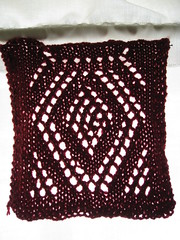
This is the swatch. Isn't it cute? I actually knit a proper swatch for this project and washed it and blocked it. And I'm very glad I did. To match the final stole size of 22" wide by 60" long, this swatch needed to be 5" wide by 6" long. No problem pinning it to that size. But after it was fully dried and released from the pins, things happened. The swatch held its width well, but the length gradually shortened to 5.25" (over about 24 hours). Pretty sneaky, huh? Not a problem, though. I have an extra skein of yarn in case I need to knit an extra repeat. Or I could block the length to 66" to allow for the subsequent shrinkage.


It's exciting to have another lace project on the needles. For continuing inspiration I have pinned the swatch to the sheer curtain that covers the hallway window, where it can remind me daily of what I should be doing.

Wednesday, May 14, 2008

BiColor Shawlette is Finished!

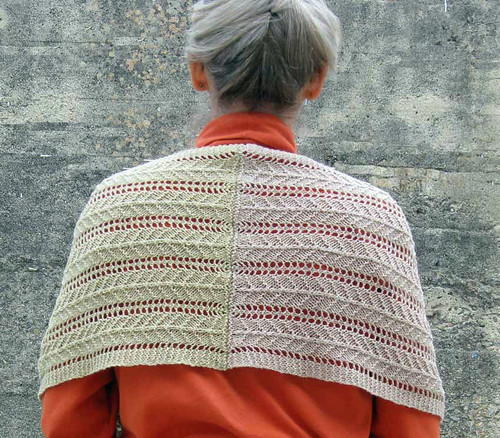
This may be my fastest knit ever. Even faster than a pair of socks, this two-color Clementine Shawlette (Interweave Knits, Spring 2007) took barely two weeks, and I was knitting on other things as well during that time.


The shawl is in two colors because I only had one skein of each color and I never intended to actually knit the whole thing. But I'm glad I did. It's perfect for summer, light and decorative – adds some glitz to the old t-shirt.

I even like the bicolor effect. Since the shawl is knit in two pieces, there's not a prayer of hiding the join at the back (graft however deviously one may). Might as well take advantage of that design feature and do something different. I'm not sure wildly contrasting colors would look good (although they might), but I could definitely see it in vivid blue and purple. Or a pinky purple joined to a bluey purple.


The little ties are perfect for holding the shawl together. They do limit the ways that you can wear it, but for a piece this small there aren't many possibilities anyway.


The Elsebeth Lavold Silky Wool made for a most intriguing knit. As much as it looks like fingering, it knit up on U.S. #5 needles just like a DK. And although it felt like string while knitting, it washed and blocked into an amazingly light and soft fabric. And it stretched a lot (as I had been warned). Not a problem for this shawl; it fact I wanted it to stretch.

For more adventures with this yarn visit Prime Time Knitter, who has just completed a sweater in Silky Wool and Obsessed With Knitting, who is making a skirt out of it (A skirt! Are you impressed? I am).