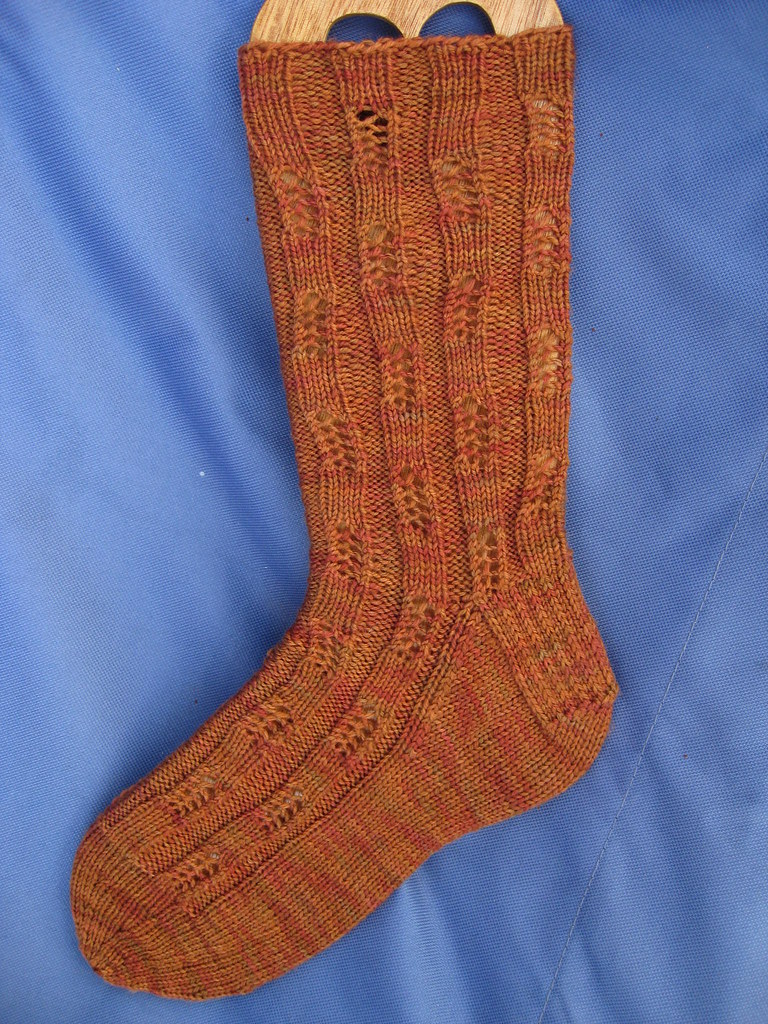
Well, I am indeed done with spinning this yarn. And I thought I was done with spinning altogether (more on that in a bit).

According to my Ravelry file I began this spinning project in June 2008 and finished it in October 2009. Rather a long time, wouldn't you say? Naturally there were some life events, like moving to the mainland, and a good bit of knitting along the way, but still.
So what is this stuff? Okay. The fiber is superwash merino from Crown Mountain Farms in the "Say A Little Prayer" colorway (Aretha Franklin song, in case you were wondering). The resulting yarn is a two-ply laceweight, of which there are 6 ounces and 1200 yards. And all of this yardage was spun and plied on spindles (as well as another two ounces that I messed up in the finishing and have put aside for some indeterminate future use).

Why laceweight? I'm not sure. It's just what the fiber wanted to be. Who am I to argue with a truly determined fiber? Just for fun I put it next to the Fiddlesticks Zephyr Laceweight I'm using to knit the Celtic Knot Stole. Take a look.

Yup, that's a laceweight. Mine is much more tightly plied than the Fiddlesticks, which may not be a good thing. We shall see when it comes to the knitting.
After taking such an incredibly long time to spin what is, after all, not so very much yarn – just enough for a nice shawl – I was feeling rather negative about the whole spinning thing. I tucked all the spindles into a basket and put them out of sight. And then . . . heh.
Then I learned that the Southern California Handweavers' Guild was having their annual fiber festival a mere 30 minutes' drive from my residence. Of course, I had to go. And of course (you can guess already, right?) I met tons of friendly, happy fiber-enablers. They showed me their spinning wheels, offered helpful tips, displayed gorgeous fibers. You know how it goes.
So, for the past week, I have been obsessively researching spinning wheels – a truly challenging task. There is a lack of clarity about terminology and functionality that is probably to be expected in a device with parts called "footman," "maiden," and "orifice." Alas, there is also a corresponding lack of solid information. Selecting a spinning wheel is not at all like buying a bicycle -- an apparatus with about the same level of complexity -- perhaps because there are far fewer spinners than there are bicyclists. Neighborhood shops do NOT abound. But I do not despair. There are 7-8 potential wheels on my current list (which leans towards smallness and foldability due to my tiny apartment), and the hunt is on!