Just a quickie (perhaps to mark the six-month anniversary of my last post??). I have moved -- again -- and Internet access here is problematic.
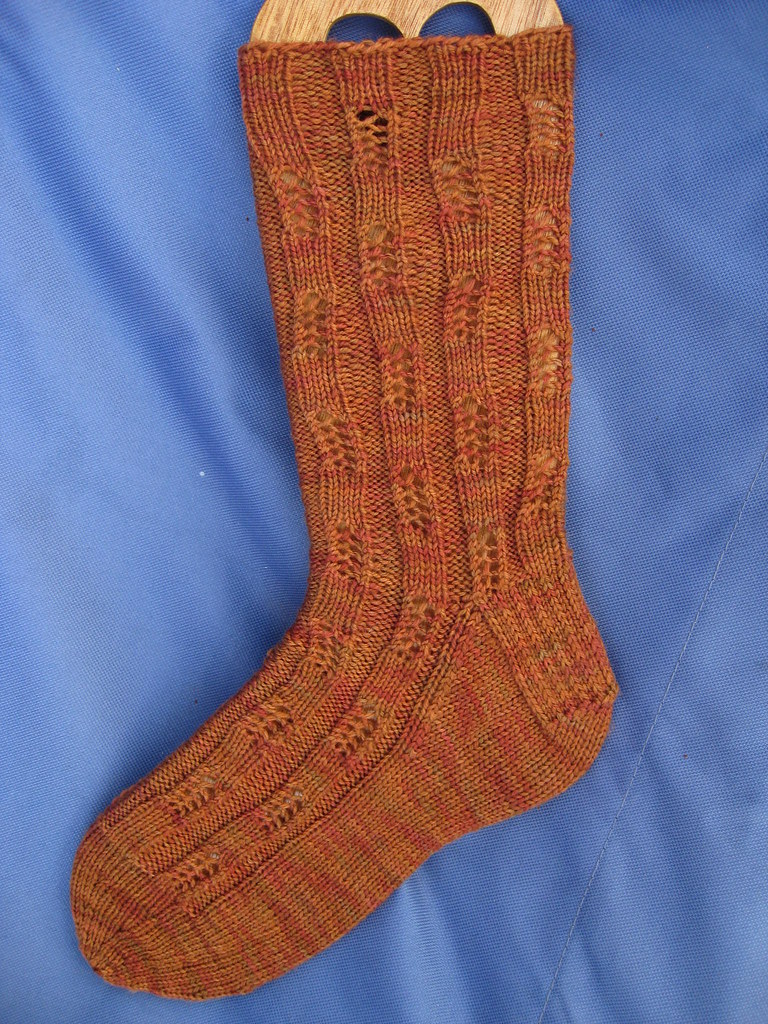
Anyhoo, I have added another free pattern link on the side. The "Staggered Lace Socks" pattern has been up on Ravelry for a while, but not available ouside the Rav world.
I'm working out another new pattern -- a pillow cover -- and should have it up in a few weeks (fingers crossed).
Friday, June 4, 2010
Another Free Pattern

Monday, January 4, 2010
Lots of Little Lacey Lessons
It is done. It is done. The Celtic Stole, my very first project with laceweight yarn, is finished at last. I may never knit with laceweight again. Love the pattern, but oh, my goodness. Knitting with thread is a whole other world. So . . . here it is -- 
This is my second stole (y'know, rectangular-type shawl), and I'm realizing that with this shape you get a lot more of the decorative part in the front, unlike the triangles, which usually have their prettiest part draped across the back. The back of a stole is not so interesting. 
Both shapes are good, and then, of course, there's circles and half-circles and all sorts of adventures to come. I'm definitely not done with shawls, although a light-to-medium fingering weight yarn may be as thin as I will go in future. Aside from the difficulty in knitting (not to mention tinking), laceweight, once blocked, is almost too drapey.
Anyhoo, I had the fun of learning two new cast-on's for this project. First the invisible cast-on for the start, and then the crochet cast-on for the knit-on border. 
I had a slight difference of opinion with the designer as to how the border should be cast on. This is due to my reluctance to break off the working yarn unless absolutely, totally, completely necessary. Other knitters are more carefree about trailing bits of yarn. So, I cast on with my working yarn, adding one stitch to the cast-on number, and then eliminated one row from the beginning. Worked just fine.
It's an amazing pattern, perfectly easy to knit (as long as you pay close attention). There are no nupps or other fancy maneuvers, just basic stitches. And, most importantly, the pattern has not a single mistake, not one, not anywhere. And, oh, by the way, it's FREE. And the chart comes as both a PDF and an Excel spreadsheet. I found the spreadsheet to be quite handy. I could change the color of the grid, increase the font size, cut out just the pieces I was working on -- all sorts of useful stuff.
My hat is off to Sarah Kendra Hughes, who created this amazing pattern and then shared it with the world, asking nothing in return. Huzzah!
Sunday, December 27, 2009
Apparently I Am A Designer
Well, we all are designers really, whether we start from scratch, modify a pattern, or cobble several patterns together into something different. But here's what happened to me.

I bought this fabulous alpaca yarn from Knitpicks intending to use it for a specific vest pattern. That so did not work out. Then I tried it with some other patterns. No and no and no. But I really wanted a vest. I vaguely remembered seeing a demonstration of a very open, lacey drop-stitch, and I stumbled upon several sideways-knit vest patterns, none of which I was exactly crazy about, but the approach is pretty much the same for all. So I used the drop-stitch idea to improvise a vest, which I liked very much.

I liked it so much that I thought of making a few more in different yarns. It didn't take long to organize my notes into something that vaguely resembled a pattern, and I thought I would simply upload a PDF to Ravelry, to join all the other free patterns available there, so that it would be available for me and for anyone else who might want to use it too.
Well, the process is not so simple. First you must designate yourself as a "designer" and give yourself a "designer name." So I did that, although I felt like a fool ("it's just a few notes," this humble little voice was whispering). There were more steps – a pattern page, a store (yes, even though it's free), links, etc., but they are all done.
The last and most difficult step has been to get a link up on my blog that will allow people who are not Ravelry members to view and download the PDF. I think I have that working, although I'm not thrilled with the way it looks. More tinkering will be needed.
It's been a fun, although sometimes frustrating, experience, and having a place to put my improvisations has inspired me to take better notes and to work harder on writing an understandable pattern. Given the problems I've had with patterns written by others, I know how incredibly difficult that can be. Just when you think you've explained it all, someone comes along with a different mindset (like me) and just doesn't get it.
Right now, I'm reverse engineering the Staggered Lace Socks into a pattern. No notes anymore, but I have the actual sock in hand, and it's easy to count rows and stitches. Soon I will have two "designs" up on Ravelry. Woohooo!!
Monday, December 7, 2009
So . . . About That Spinning Wheel . . .
I have, in fact, purchased a spinning device. Notice, I did not say "spinning wheel." Although extensive research into spinning terminology suggests that this device may be considered to be generically a "wheel" despite the absence of an actual wheel. No treadles either. No footmen. Have you guessed yet?

Yep, it is an e-spinner. A HansenCrafts miniSpinner to be precise. What we have here is an Ashford jumbo flyer with sliding-hook yarn guide in Kevin Hansen's beautifully carved mount with a tiny but super powerful motor in the base. Also comes with a foot pedal that operates in two modes. I love it.

Alas, on the day it arrived I had just come down with a dreadful head cold and could do no more than set it on the table next to my laptop and admire it from afar between sniffles, sneezes, and naps.
But then, oh, then . . . when I began to feel better . . . I put the miniSpinner on a low table to the right side of the bed, plugged it in, piled my fiber on the left side of the bed, lay back on my pillows, and spun. Now that was fun!
The whole process was so different from spindling that I had trouble at first determining when the fiber had enough twist in it that I should allow it to wind onto the bobbin. Working with some hairly, snarly Coopworth/Columbia blend acquired several years ago, I drafted away, struggling to keep up with the spinner (at one of its lowest speed settings). But it got easier, and by the second bobbin I was doing better.

Plying was really exciting. No worries about direction. Instead of flipping the switch to the right, I flip it to the left. Done deal. Woohoo! And this is where the speed is seriously great. It was so quick that I had to remind myself to stop from time to time to move the yarn guide. The only oopsie came when I got down near the end of my singles. That stuff I spun at the beginning of the very first bobbin? Uh, not so spun. It just fell apart. Heh. Lesson learned.
So here is what I have to show for my first spinning experience. About 100 yards of a more-or-less-worsted weight "rustic" yarn.

It's the oddest stuff; reminds me a little of the Knitpicks Suri Dream I used recently to make a vest, although it is not nearly so soft. But, just like Suri Dream, there is a narrow core of yarn with a fairly decent twist and then a lot of hairs sticking out that make it much thicker. I certainly didn't set out to create this effect (wouldn't know how), so I'm guessing it's a feature of the fiber, which came with its own supply of little twigs, nicely embedded, no extra charge.
It feels strange to be a beginner again. I had just got to the point where I could reliably and consistently spin any thickness whatever on a spindle. Now I need to learn to do the same on my "wheel." Much fun to come.
Tuesday, November 17, 2009
Alpaca Heaven
The highlight of this past weekend for me was a visit to AlpacaFest West. The name says it all – loads of lovely alpacas of all colors and kinds, fiber on the hoof. And so gorgeous. Just look at that cutie little face . . . 
As much as I have read descriptions of the two types of alpaca – Suri and Huacaya, it took an up-close-and-personal look to get the idea across. This guy with the dreadlocks is a Suri – 
And these two lovelies are Huacayas. They're even fluffier than they look in the picture -- 
Although there were a dozen or so vendors selling fiber, yarn, garments, etc., the focus of the show was on the competition. The alpacas were judged in different classes based on age, gender, type, and probably some other stuff I've forgotten. Here's one lineup waiting for the judge to check them out -- 
It was fascinating to watch all the different alpacas parade past and to listen to the judge explain her reasons for ranking one higher than another. "Conformation" was important. And fleece, of course! And evidently the shape of the jaw was a factor as well.
Here's one happy winner in the "two year old males" category. I was rooting for him because of that stunning cinnamon color. -- 
And a special thanks to Ranch of the Oaks for posting a notice of this event on Ravelry. 
They had all sorts of lovely goodies. If you look closely, you will see a table piled up with yarn in the back of the booth. Not just alpaca either. And the ball bands were usually labeled with the name of the animal the fiber came from. I love that.
Altogether a perfect day.
Sunday, November 8, 2009
I Thought I Was Done
Well, I am indeed done with spinning this yarn. And I thought I was done with spinning altogether (more on that in a bit).

According to my Ravelry file I began this spinning project in June 2008 and finished it in October 2009. Rather a long time, wouldn't you say? Naturally there were some life events, like moving to the mainland, and a good bit of knitting along the way, but still.
So what is this stuff? Okay. The fiber is superwash merino from Crown Mountain Farms in the "Say A Little Prayer" colorway (Aretha Franklin song, in case you were wondering). The resulting yarn is a two-ply laceweight, of which there are 6 ounces and 1200 yards. And all of this yardage was spun and plied on spindles (as well as another two ounces that I messed up in the finishing and have put aside for some indeterminate future use).

Why laceweight? I'm not sure. It's just what the fiber wanted to be. Who am I to argue with a truly determined fiber? Just for fun I put it next to the Fiddlesticks Zephyr Laceweight I'm using to knit the Celtic Knot Stole. Take a look.

Yup, that's a laceweight. Mine is much more tightly plied than the Fiddlesticks, which may not be a good thing. We shall see when it comes to the knitting.
After taking such an incredibly long time to spin what is, after all, not so very much yarn – just enough for a nice shawl – I was feeling rather negative about the whole spinning thing. I tucked all the spindles into a basket and put them out of sight. And then . . . heh.
Then I learned that the Southern California Handweavers' Guild was having their annual fiber festival a mere 30 minutes' drive from my residence. Of course, I had to go. And of course (you can guess already, right?) I met tons of friendly, happy fiber-enablers. They showed me their spinning wheels, offered helpful tips, displayed gorgeous fibers. You know how it goes.
So, for the past week, I have been obsessively researching spinning wheels – a truly challenging task. There is a lack of clarity about terminology and functionality that is probably to be expected in a device with parts called "footman," "maiden," and "orifice." Alas, there is also a corresponding lack of solid information. Selecting a spinning wheel is not at all like buying a bicycle -- an apparatus with about the same level of complexity -- perhaps because there are far fewer spinners than there are bicyclists. Neighborhood shops do NOT abound. But I do not despair. There are 7-8 potential wheels on my current list (which leans towards smallness and foldability due to my tiny apartment), and the hunt is on!
Sunday, October 18, 2009
What Is Heard Is Not What Is Said **
Although I have not yet finished the Celtic Stole, I have already started the Strawberry Pie Shawl. Two shawls on the needles at the same time – shocking, is it not? But I could not wait.

Oddly enough, this relatively simple pattern gave me all sorts of trouble. I could not make sense of the directions. Clearly the designer and I spoke different dialects of pattern-ese. I attempted to chart the little strawberries, and, after a good bit of symbol shifting, came up with this --

The strawberries are correct and the spacing is correct. Good. Now I could cast on. But I was still convinced that some of the directions were "wrong." Heh.
So I decided it would be fun and educational to translate the chart into my dialect of pattern-ese. Oh, did the light ever dawn!

See that pencilled square? Those ten stitches are the "strawberry." That's the bit that is repeated across. And in that context, every single word of the instructions is completely correct. What was wrong was . . . well, I guess, my brain. I simply wasn't reading the pattern the way it was intended to be read.
Here's the scary part -- if it's possible to so thoroughly misunderstand something as focused and specialized as knitting instructions, what does that say about the possibilities for misunderstanding in the wider world? How often do we think someone is "wrong," when we simply are not listening? (And don't even get me started about the "sound bites" on news shows. Aaaargh!)
**from "Who Ordered This Truckload of Dung?" by Ajahn Brahm
Subscribe to:
Posts (Atom)