Tuesday, February 28, 2012

Endless I-Cord

I have finally begun the finishing process for an Adult Surprise Jacket on which I had completed all the knitting at least nine months ago. Why did I wait so long? Oooh, now I remember. I had decided to do an i-cord bindoff, then do applied i-cord along the shoulders and sleeve cuffs, and the sew the shoulders together.

Just like the original Baby Surprise Jacket, by the time you are done knitting the adult version the ENTIRE sweater is crowded onto a 60" circ; this includes both front edges and the bottom edge all the way around. Here's a pic of a Baby Surprise Jacket right before binding off.


So yesterday I began the bindoff, working on it pretty much all day and into the evening. And here is where I was at the end of the day – down one front, all the way around the bottom, and part way up the other front.


It is an extremely slooooow process.


For those unfamiliar with this fun, you cast on three stitches (the beige ones). Then on every row you knit the first two stitches and knit the third stitch together with the body stitch (green) thru the back loop. Then you have to put all three stitches BACK on the left needle, pull the yarn tight, and keep on truckin'. It requires a certain amount of attention, but is also quite soporific – not a good combination.


Time for a few rousing choruses of "We Shall Overcome."

Tuesday, January 24, 2012

In Which I Discover the Band Heel

I've been knitting a mosaic sock pattern (Diamond Mosaic from Charlene Schurch's "More Sensational . . . " book) and wanted to continue the pattern all the way down the foot. This is, of course, next to impossible if one prefers the traditional flap-and-gusset heel. The additional gusset stitches and subsequent decreases are an insurmountable problem. The patterns in the book are no help; they avoid the entire issue by showing the patterning only on the leg.

Another option, which I used on my first pair of mosaic socks, is to transition into a pin stripe on the foot. Negotiating the two colors through the gusset decreases requires a bit of attention, but it's not too difficult.


The obvious solution is a short-row heel. No gusset, no worries. But I had used that heel on these socks a few years ago and didn't like it at all. Something about the shape and/or sizing of the short-row heel just doesn't fit my feet well. Luckily the same book that had the pattern for the "Ukrainian Socks" (Nancy Bush's "Folk Socks") has a HUGE section on heel and toe variations. And that's where I discovered the band heel.


I'm still trying to figure out how the magic happens, but I followed the directions and it worked. You start out with an ordinary heel flap on half the stitches (in this case 30). Then life gets interesting. You do just a few decreases on either side of the six-stitch "band". Okay so far. But then . . .


While doing short rows to turn the heel you maintain the six-stitch band in the middle. For some reason I don't yet understand this causes the heel turn to be much longer than usual and you have far fewer stitches than usual left at the end – only the band, actually.


Thus, when you go to pick up all the necessary stitches along the side of the flap, there are no extra stitches that need to be decreased away – just the original 30. When next I use this heel I would do one thing differently – four stitches, instead of six, for the band. It seems the fewer stitches you have at the end of the heel turn, the more you can pick up, and thus the longer can the heel flap be. And I like looong heel flaps.


But it all came out well enough. The first sock is done, with a star toe at the end -- using both strands of yarn, since I have been reminded recently of the fragility of sock toes (see prior blog post). All that remains is to knit one more.

Saturday, December 31, 2011

Save Those Yarn Squibs!

Only a few days ago I finished reknitting the toe of a sock made from handspun yarn, my very first handspun, actually. A dreadful hole (three toes wide!) had sprouted. And, of course, this was a pattern with cables and twisted stitches which I had decided to carry ALL the way down to the very end of the toe. Fortunately I had a little bit of leftover yarn, so I soldiered on – ripped back past the hole, got all the stitches onto needles, figured out how to manage the decreases and the pattern, and we were done. No need to do that again for a long time, right?

So today, guess what? Yeah, this –


Could I be so lucky again as to have leftover yarn? YES! Two little squibs ready for action. This one was much easier, partly because I'd just gone through the same geblinkin' process mere days before and partly because the toe was a simpler construction – a star toe in stockinette.


Once again – rip, get stitches on needles, tink some, figure out where we are, and onward.


What have I learned? When knitting socks with handspun yarn, always use a nice sturdy commercial yarn for the toe. Other spinners may be able to produce toe-proof yarn, but clearly I cannot. Oh, and lesson number two – always save leftover yarn, no matter how tiny the squib.

Saturday, November 26, 2011

Bulky Yarn + Fat Needles = Finished Object

I have never before knit with bulky yarn. Nor with U.S. # 13 needles. It felt like manipulating tree trunks. But in less than a month, ta-daaaaa !


This is the Abrazo vest, a free pattern from the Fall 2008 issue of "Knitty." It's actually written for "super bulky" yarn, so I had to knit a size up to get a good fit. Of course I had to make a few adjustments to the pattern cuz I didn't entirely approve of the designer's choices: I left off the "shaping," made the shoulders wider, put a garter border at the armhole edge, and re-engineered the center back . . . nothing much really.

No complaints about the yarn either. This is Knitpicks Cadena, 70% wool and 30% alpaca. (Yes, ALPACA – my greatest fiber love!)

And the frosting on the cake? Total frugality. Cadena is just under $6 per skein, and the vest used three skeins. Soooooo. . . yes, a custom-fit, wool/alpaca vest (with cables) for under $18.

Monday, October 24, 2011

Roses and Roses and Roses

I went to the Orange County Rose Society's 2011 exhibition this past weekend.  Lots and lots of amazing roses. 


They were large, tiny, scented, unscented, and colors I'd never seen. Here's just a few.


This is a miniature rose, barely two inches across, floating in a silver dish. The colors are difficult to capture. The red is a medium deep maroon, and the yellow is an intense light gold.


This doesn't look like a rose at all, does it? There were a few others of the same form, more daisy-like than rose-shaped.


I love the combination of yellow and pink on this one


Yet again a traditional rose shape (with lots of petals!), but multi-colored – deep pink and white.


The curling petals on this one definitely curled my toes.


I think this one might be my favorite – just enough petals to look like a rose, but not so many as the pink-and-white one. And that incredible pale pink with deeper pink at the edges – yum!


I didn't get any pictures of the roses that won the prize for best scent. Darn! One was peach-colored and had a deep, almost musky scent, and the other was lavender with a lighter, sharper smell. Both wonderful.

Sunday, September 4, 2011

Color in Spindling

It all began with an itch to use the long-neglected spindles. Then I found this.


Madly inexpensive Brown Sheep Mill Ends from Suzoo's Woolworks. There was a lot of blue, a moderate amount of yellow, and just a bit of red. It didn't even occur to me until much further along that these are the three primary colors.

Of course yarn isn't paint. You can't expect to combine blue and yellow to make green. And yet . . . . Look at this first ply.


I used 15 grams of yellow and 10 grams of blue, feeding them in more-or-less side by side.

The second ply was almost all blue with little bits of red spun in at random intervals throughout.


Then I plied both singles together, ending up with 5o grams and 260 yards of light fingering with a predominant look of blue, but other colors mixing in here and there. I think I like it.


Here's a close-up:


Interestingly, these "mill ends" were some of the best fiber I have ever spun – soft, smooth, and super easy to draft.

There are two similar singles waiting to be plied, for a total of about 500 yards. Not sure what to do with this yarn. It's too pretty for socks. Maybe a little neckpiece?

Friday, June 4, 2010

Another Free Pattern

Just a quickie (perhaps to mark the six-month anniversary of my last post??). I have moved -- again -- and Internet access here is problematic.

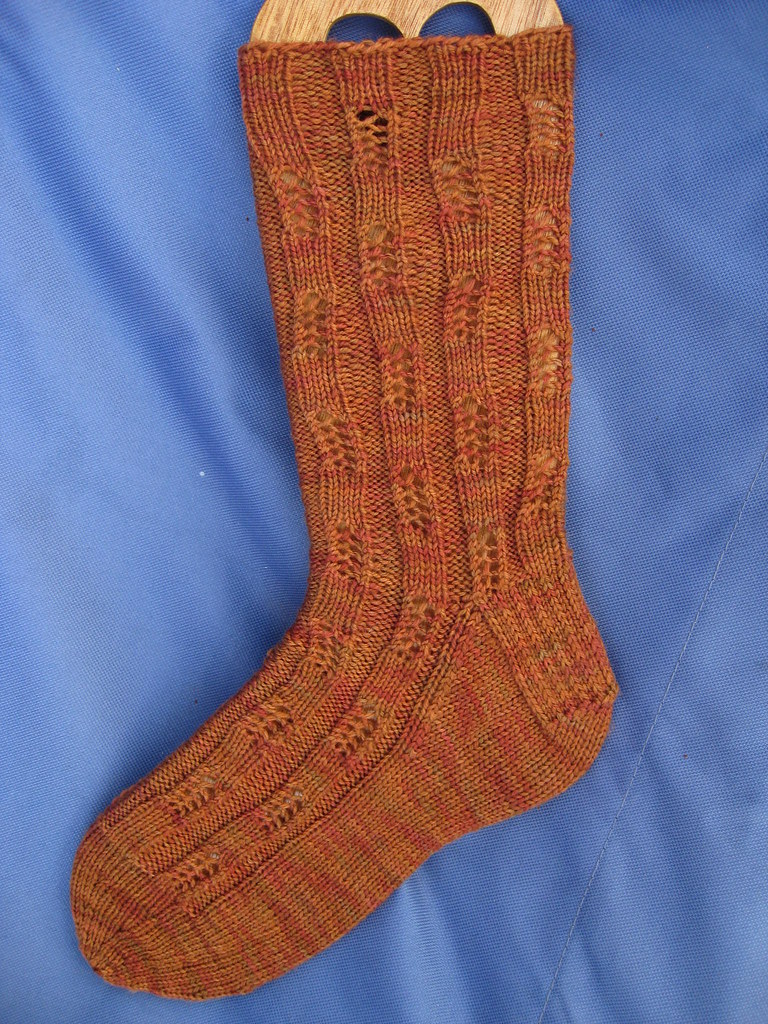
Anyhoo, I have added another free pattern link on the side. The "Staggered Lace Socks" pattern has been up on Ravelry for a while, but not available ouside the Rav world.

I'm working out another new pattern -- a pillow cover -- and should have it up in a few weeks (fingers crossed).